Dogecoin's Market Cap Dwarfs Entire NFT Sector Amidst Market Shift
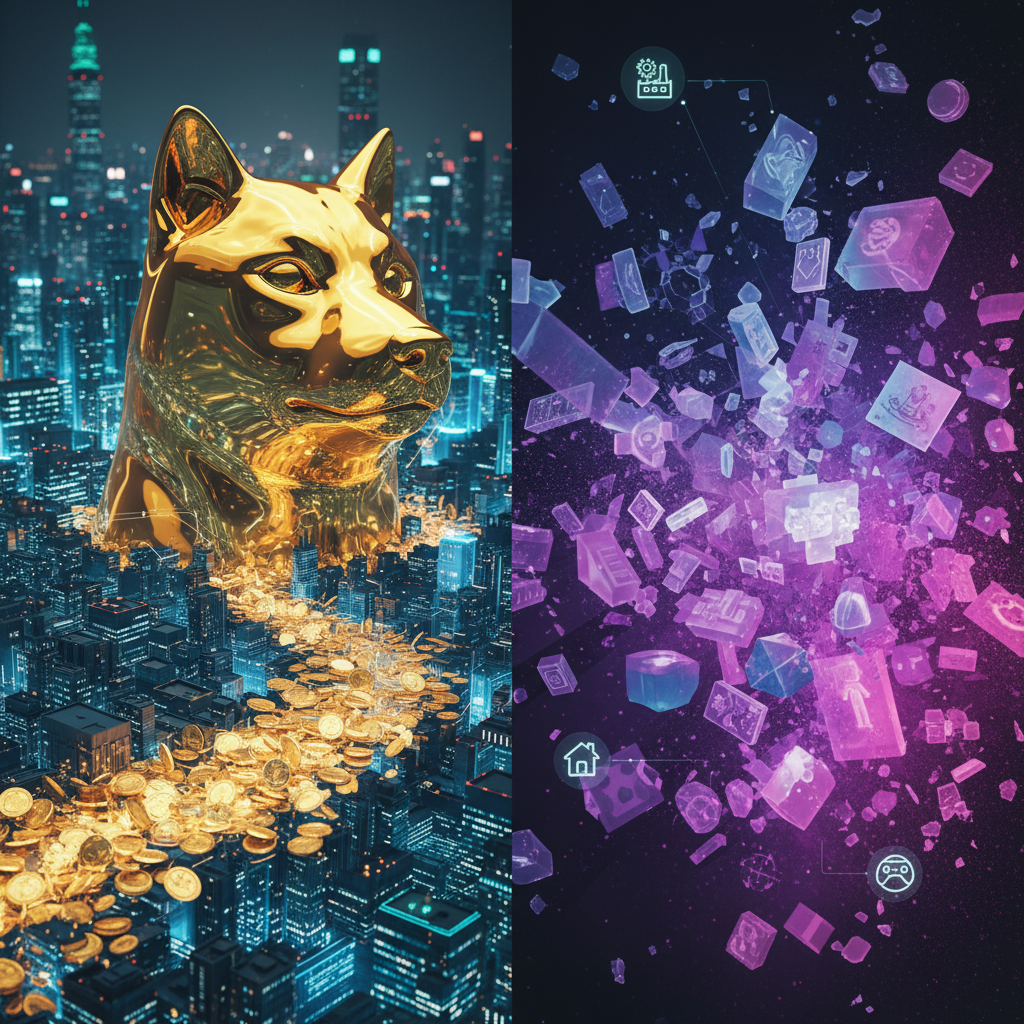
In a striking illustration of the evolving digital asset landscape, the market capitalization of Dogecoin (DOGE), the quintessential meme-inspired cryptocurrency, has reportedly surged to more than eight times the value of the entire Non-Fungible Token (NFT) market. This data, highlighted by CoinGecko, underscores a significant shift in investor sentiment and market dynamics within the broader crypto ecosystem.
As of recent reports, Dogecoin boasts a market cap nearing $26 billion, while the collective valuation of the global NFT market stands at approximately $2 billion. This considerable disparity points to a renewed focus on established, albeit volatile, cryptocurrencies and a challenging period for the NFT sector, which has been described as 'struggling' amidst broader market volatility.
The Shifting Landscape of Digital Assets
Dogecoin's recent momentum has been fueled by substantial on-chain whale activity, with analytics firm Santiment reporting 739 transactions exceeding $100,000 within a single day—the highest level of whale activity observed in six months. Furthermore, the 149 largest wallets holding at least 100 million DOGE now control an all-time high of 108.52 billion DOGE, collectively valued at approximately $11.6 billion. This aggressive accumulation is believed to have played a crucial role in DOGE's recent 14% rally over the past ten days, even as the broader crypto market experiences fluctuations.
Conversely, the NFT market, once a beacon of speculative frenzy and multi-million dollar digital art sales, appears to be recalibrating. While initial exuberance led to astronomical prices for digital collectibles in 2021 and 2022, the market has since witnessed a significant cooling period. Many industry observers now note a distinct shift away from purely speculative, profile-picture (PFP) focused projects towards utility-driven NFTs.
NFTs: From Speculation to Utility
The narrative surrounding NFTs has fundamentally changed. The era of digital art selling for millions based purely on hype seems to have largely receded. Instead, the market is increasingly valuing NFTs that offer tangible utility or real-world applications. These include NFTs representing real-world assets (RWAs), digital identity solutions, verifiable intellectual property, and crucial in-game assets within the burgeoning Web3 gaming (GameFi) sector.
Platforms like Pixels, Parallel, and Illuvium exemplify this trend, demonstrating substantial trading volumes for in-game items such as weapons, land, skins, and characters. Experts suggest that functionality has replaced blind speculation as the primary source of value in the NFT world, marking a 'washout phase' that is purging low-quality projects and making way for sustainable ecosystems built by genuine developers.
The integration of NFTs into gaming allows players true ownership of digital assets, fostering player-driven economies where virtual adventures hold real value. Beyond gaming, NFTs are also exploring roles in enhancing supply chain management, logistics, and even providing un-hackable digital passports for storing credentials and medical records securely on-chain.
Implications for Investors and Creators
For investors, this market correction signals a need for a more discerning approach. The focus is no longer on chasing volatile digital art but on identifying projects with clear use cases and long-term viability. Investing in the underlying blockchain networks that power these smart contracts, or in NFTs that offer real-world benefits like access to exclusive events or communities, is becoming the preferred strategy.
Creators, too, are adapting, with an emphasis on developing NFTs that provide inherent value and integrate seamlessly into broader digital and even physical ecosystems. The shift underscores a maturation of the NFT space, moving it beyond a niche speculative asset class towards a foundational technology for digital ownership and interaction in Web3 and the metaverse.
While Dogecoin's significant market cap relative to the NFT sector may appear to highlight a struggling digital collectible market, it more accurately reflects a market in transition. The future of NFTs lies not in fleeting trends but in their inherent ability to provide verifiable, secure, and utility-driven digital ownership, a fundamental building block for the next iteration of the internet.