Bitcoin Miners Accelerate AI Pivot Amidst Q1 Headwinds, TeraWulf Leads Shift
The landscape of cryptocurrency mining is undergoing a significant transformation, with major players increasingly diversifying their operations towards artificial intelligence (AI) and high-performance computing (HPC) services. This strategic pivot is becoming more evident as companies grapple with fluctuating Bitcoin profitability, especially in the wake of recent halving events, and the surging demand for AI infrastructure.
Recent financial reports from prominent miners underscore this shift. TeraWulf (NASDAQ: WULF), a notable Bitcoin mining firm, reported a substantial net loss exceeding $427 million in the first quarter of 2026, a stark contrast to its $61.4 million loss in Q1 2025. Despite this challenging quarter, a significant portion of the company's revenue, 60% or $21 million, was generated from its burgeoning AI compute segment, representing a remarkable 117% increase from the previous quarter. Conversely, TeraWulf's Bitcoin mining revenues saw a 50% contraction during the same period, highlighting the growing economic importance of its AI ventures.
Strategic Diversification Driven by Market Dynamics
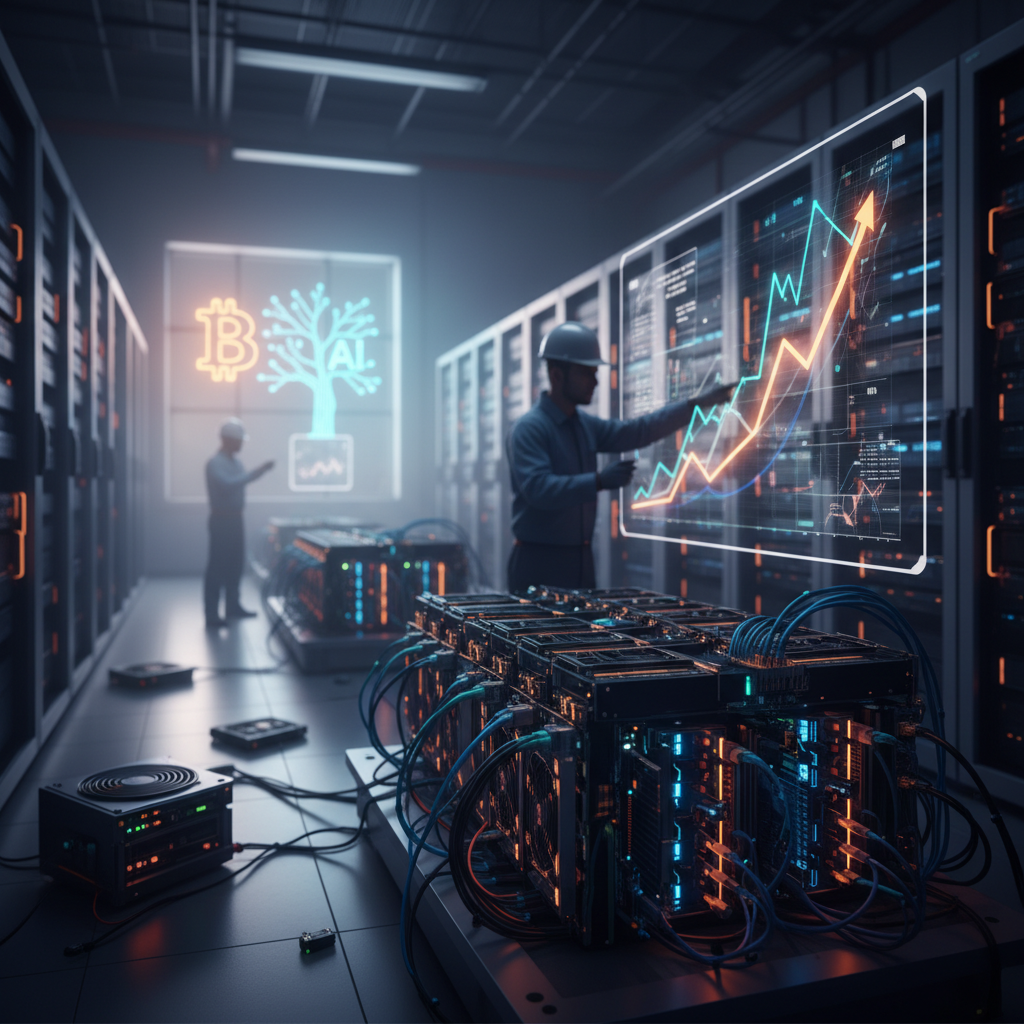
The move into AI and HPC is a calculated response to several converging factors. The Bitcoin mining industry operates on thin margins, heavily influenced by the price of Bitcoin, network difficulty, and energy costs. The Bitcoin halving event in April 2024, which reduced block rewards by 50%, has intensified pressure on miners to find alternative revenue streams and optimize operational efficiency. While Bitcoin's price hovered around $80,058 as of Friday, May 8, 2026, marking a 12% increase over the last 30 days, profitability for miners remains a persistent concern.
The core mechanism of Bitcoin's difficulty adjustment means that as more miners join the network or deploy more powerful hardware, the computational challenge to find a new block increases. Conversely, if hashrate declines, difficulty adjusts downward to maintain a consistent block time. This automatic adjustment, while ensuring network stability, means miners must constantly upgrade equipment or secure cheaper energy to remain competitive. Reports indicate the Bitcoin network experienced a -2.30% difficulty adjustment on May 1st, bringing it to 132.47 Terahashes (T), with another estimated downward adjustment of -1.06% around May 16th. Such adjustments reflect ongoing shifts in network hashrate and miner participation, influencing overall profitability.
For companies like TeraWulf, leveraging existing energy infrastructure and data center capabilities for AI computation presents a logical and lucrative diversification strategy. High-performance computing, essential for training complex AI models, requires immense power and specialized cooling systems – resources that Bitcoin miners already possess. The rapid expansion of the AI sector has created an unprecedented demand for such infrastructure, offering a more stable and potentially higher-margin revenue stream compared to the volatile nature of crypto mining.
HIVE Digital Technologies Follows Suit
Another major player, HIVE Digital Technologies (NASDAQ: HIVE), is also aggressively pursuing opportunities in the AI and HPC space. On Friday, May 8, 2026, HIVE announced investments in new fiber infrastructure at its Grand Falls, New Brunswick campus, explicitly aimed at repositioning the company towards AI and high-performance computing services. This initiative demonstrates a broader industry trend where established Bitcoin miners are reallocating capital and resources to capitalize on the booming AI market, viewing their existing energy grids and data centers as foundational assets for future growth.
The pivot by companies like TeraWulf and HIVE suggests a maturing industry adapting to new economic realities. By diversifying into AI, these companies aim to de-risk their business models from the sole reliance on Bitcoin's price performance and mining profitability. This strategic evolution could see many traditional Bitcoin mining companies transform into hybrid data center operators, offering a blend of digital asset mining and high-value AI compute services to a global clientele.