
Blur's Market Strategy Under Scrutiny Amidst Token Plunge and Lending Innovation
The non-fungible token (NFT) marketplace Blur finds itself at a pivotal juncture, navigating a highly competitive landscape with a distinctive strategy centered on professional traders. While its zero-fee model continues to attract high-volume activity, recent data reveals a significant drop in its native token's value and ongoing debates surrounding its innovative, yet controversial, lending protocol. The developments underscore the persistent volatility and evolving dynamics within the broader NFT ecosystem.
Blur burst onto the scene by prioritizing experienced traders, distinguishing itself with a 0% marketplace fee. This strategic move aims to entice high-frequency trading, potentially saving active users substantial amounts compared to platforms like OpenSea, which charges a 0.5% fee on sales. For professional traders operating with significant capital and frequent transactions, minimizing fees can drastically improve profit margins. However, this aggressive fee structure comes at a cost: a reduction in income for creators. Traditionally, marketplaces derive revenue from transaction fees, a portion of which can be directed to artists through royalties. Blur's approach signals a clear focus on the liquidity providers and traders, rather than the initial creators, shaping a distinct market segment.
The Battle for Market Share: Blur vs. OpenSea
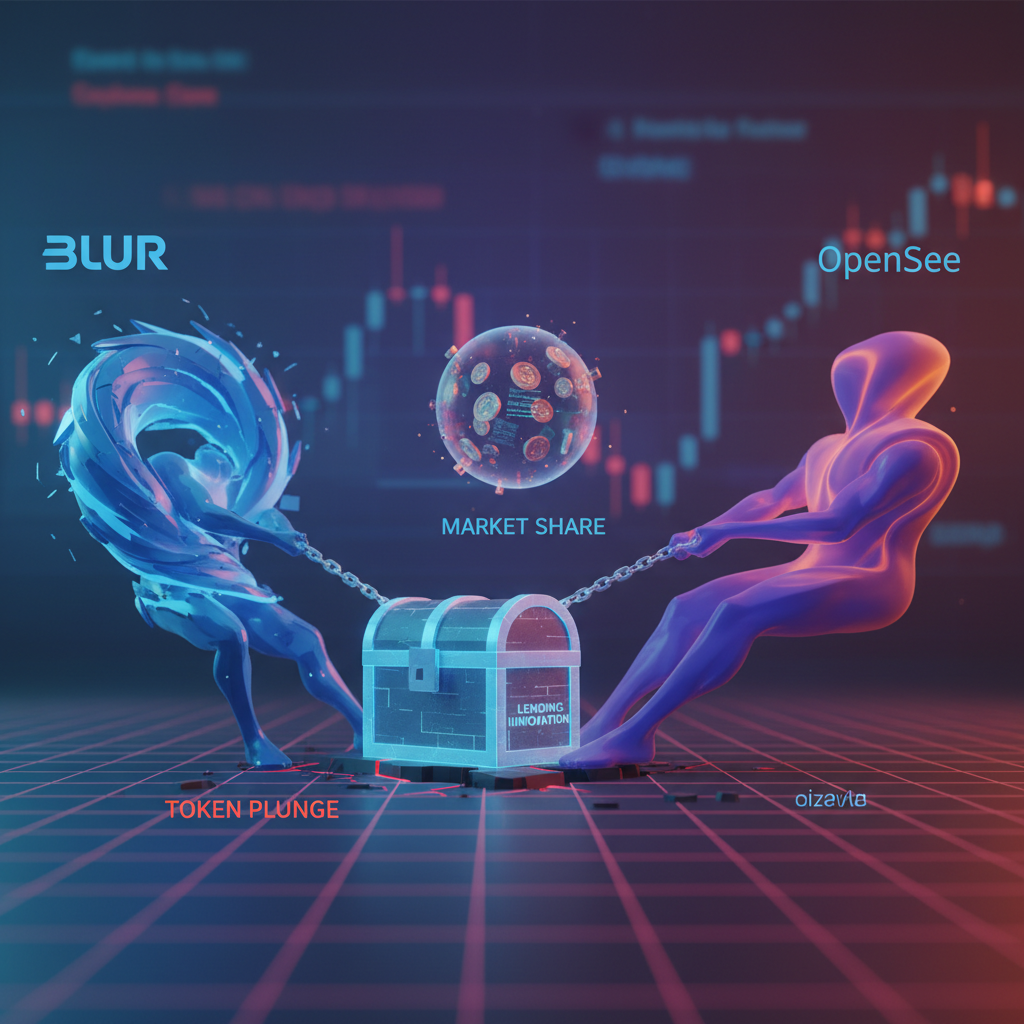
Despite its appeal to professional traders, Blur continues to trail its more established competitor, OpenSea, in terms of overall user base. As of 2026, Blur reportedly has approximately 38,300 monthly active users, a stark contrast to OpenSea’s robust 382,000 monthly active users. This disparity highlights the challenge Blur faces in broadening its appeal beyond a niche of experienced traders to a more mainstream audience, including casual collectors and new entrants to the NFT space. OpenSea, often considered the 'Amazon of NFTs,' benefits from a first-mover advantage and a user-friendly interface that caters to a wider demographic.
The marketplace landscape is characterized by constant innovation, with platforms striving to offer unique features that attract and retain users. Blur's success in capturing significant trading volume is undeniable, often outperforming rivals in that metric. However, maintaining a healthy ecosystem requires a balance between trading activity, creator incentives, and user growth across all segments. The ongoing competition between these dominant platforms ultimately benefits the NFT market by driving innovation and refining user experiences.
Token Performance and Lending Protocol Under Scrutiny
Accompanying the marketplace's competitive strategies, the performance of Blur's native token, BLUR, has raised concerns. The token has experienced a dramatic decline, plummeting by an staggering 99.6% from its all-time high of $5.02 in February 2023 to around $0.02 in May 2026. This precipitous drop mirrors a broader downturn observed across the NFT market and can be attributed to increased selling pressure from a rising circulating supply of the token. Investors in the volatile crypto market often scrutinize tokenomics – the study of how a cryptocurrency's economic system works – and significant supply increases without corresponding demand can lead to price depreciation.
Adding another layer of complexity is Blur’s Blend lending protocol, a significant innovation designed to allow NFT holders to borrow Ethereum (ETH) against their NFTs without fixed fees or expiry dates. While Blend aims to unlock liquidity for NFT assets, it garnered controversy in 2024 due to mass liquidations triggered by market volatility. NFT lending protocols enable users to leverage their digital assets, but they also expose participants to liquidation risks if the value of their collateralized NFTs drops below a certain threshold. The mass liquidations underscored the inherent risks of such financial instruments within the nascent and often unpredictable NFT market, serving as a cautionary tale for both lenders and borrowers.
Despite the challenges associated with its token performance and the controversies surrounding Blend, the lending protocol remains a notable development in NFT infrastructure. By facilitating new financial use cases for NFTs, Blur continues to push the boundaries of what these digital assets can achieve beyond mere collection or speculation. This focus on advanced financial tooling, combined with its trader-centric marketplace, firmly positions Blur as a key player in the professional segment of the NFT market, shaping its future evolution amidst ongoing volatility and scrutiny.