
Bitcoin Mining's Dire Straits: High Costs Force Pivot to AI
The global Bitcoin mining industry is currently navigating a period of severe financial strain, as soaring production costs clash with a stagnant Bitcoin price and near-zero transaction fees. This profitability crunch is forcing many miners to reassess their operations, with some resorting to asset sales and a strategic pivot towards artificial intelligence (AI) infrastructure as a lifeline.
Mounting Costs and Dwindling Margins
Recent reports indicate that the weighted average cost to produce a single Bitcoin has climbed to approximately $79,995 as of the end of last year, a figure that now frequently surpasses the market price of the cryptocurrency itself. Bitcoin has been trading slightly above $70,000, placing many miners in an unprofitable position. This precarious situation has persisted since early February, with miners effectively spending more to mint new coins than they can sell them for.
Adding to the pressure, transaction fees, which historically supplemented block rewards, are currently hovering near zero. This leaves miners almost entirely reliant on the block reward for revenue, making them acutely sensitive to fluctuations in Bitcoin's price and their operational expenditures, primarily electricity costs and hardware efficiency. The analogy drawn to the U.S. government's decision to retire the penny due to its unprofitability resonates strongly within the mining sector, highlighting the existential threat faced by operators whose costs exceed their output value.
Upcoming Difficulty Adjustment and Industry Shift

The Bitcoin network's difficulty adjustment mechanism is designed to maintain a consistent block production time, increasing or decreasing based on the total computational power (hashrate) dedicated to mining. While the current Bitcoin difficulty stands at 138.97 Trillion, with a 0.00% change in the last 24 hours, relief might be on the horizon. The next adjustment, estimated for April 18, 2026, is projected to bring a decrease of approximately 5%, lowering the difficulty from 138.97 T to 132.14 T. Historically, a drop in difficulty could offer some respite to miners by making it easier to find blocks and earn rewards. However, this adjustment comes amid a broader climate of miner stress, suggesting that any relief might be marginal given the underlying profitability issues.
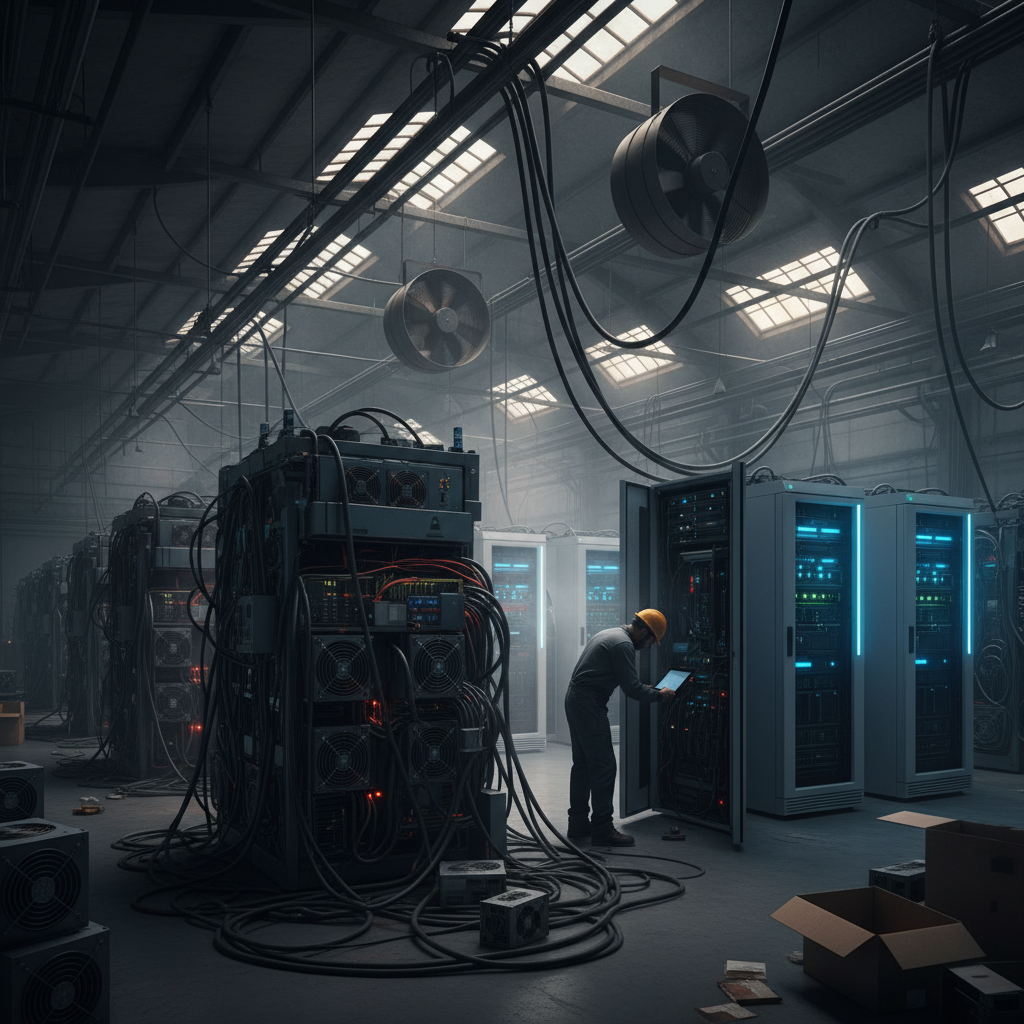
In response to these challenging market conditions, many Bitcoin mining companies are undertaking drastic measures. Some are shutting down operations, selling off mining equipment, and liquidating Bitcoin holdings to bolster their cash reserves. Critically, a significant trend emerging is the strategic pivot towards high-performance computing, specifically in the realm of Artificial Intelligence. Companies like TeraWulf are blurring the lines between crypto mining and AI infrastructure provision, a path successfully charted by entities such as CoreWeave. This transition allows miners to leverage their existing infrastructure and access to cheap energy for a different, potentially more lucrative, industry.
AI Competition for Energy and Future Outlook
This pivot, while offering a potential escape route from the Bitcoin mining profitability crisis, introduces a new layer of competition: the surging demand for energy from AI data centers. Reports indicate that major AI players, such as Anthropic, are actively securing massive amounts of power, with deals locking up gigawatts of electricity. This directly pits former Bitcoin miners, now repurposed for AI, against dedicated AI infrastructure providers in the race for affordable and reliable energy, which is a foundational requirement for both industries.
The confluence of high production costs, low fees, and intense competition for energy resources paints a challenging, yet transformative, picture for the Bitcoin mining industry. While the upcoming difficulty adjustment may offer minor operational improvements, the long-term survival strategy for many miners increasingly appears to lie in diversifying their revenue streams and embracing the burgeoning AI sector. This shift marks a significant evolution, as the infrastructure originally built to secure decentralized finance finds new purpose in powering the future of artificial intelligence.