
Peaq Network Powers Autonomous Delivery Robot with On-Chain USDT Payments
In a significant stride for the Decentralized Physical Infrastructure Network (DePIN) sector, the Peaq network recently showcased a delivery robot autonomously executing payments in Tether (USDT) on-chain. This demonstration, highlighted on May 22, 2026, signals a tangible leap forward for the burgeoning machine economy, illustrating how blockchain technology can enable devices to operate and transact independently in real-world scenarios.
The event featured a Serve Robotics delivery bot navigating a simulated urban environment in Seoul using NAVER Maps. Crucially, the robot completed deliveries and processed payments via Tether's Wallet Development Kit, with the Solana blockchain acting as the underlying settlement layer. This practical application underscores the growing utility of blockchain beyond traditional financial instruments and speculative trading, moving into the realm of everyday services.
DePIN: Fueling the Future of Connected Infrastructure
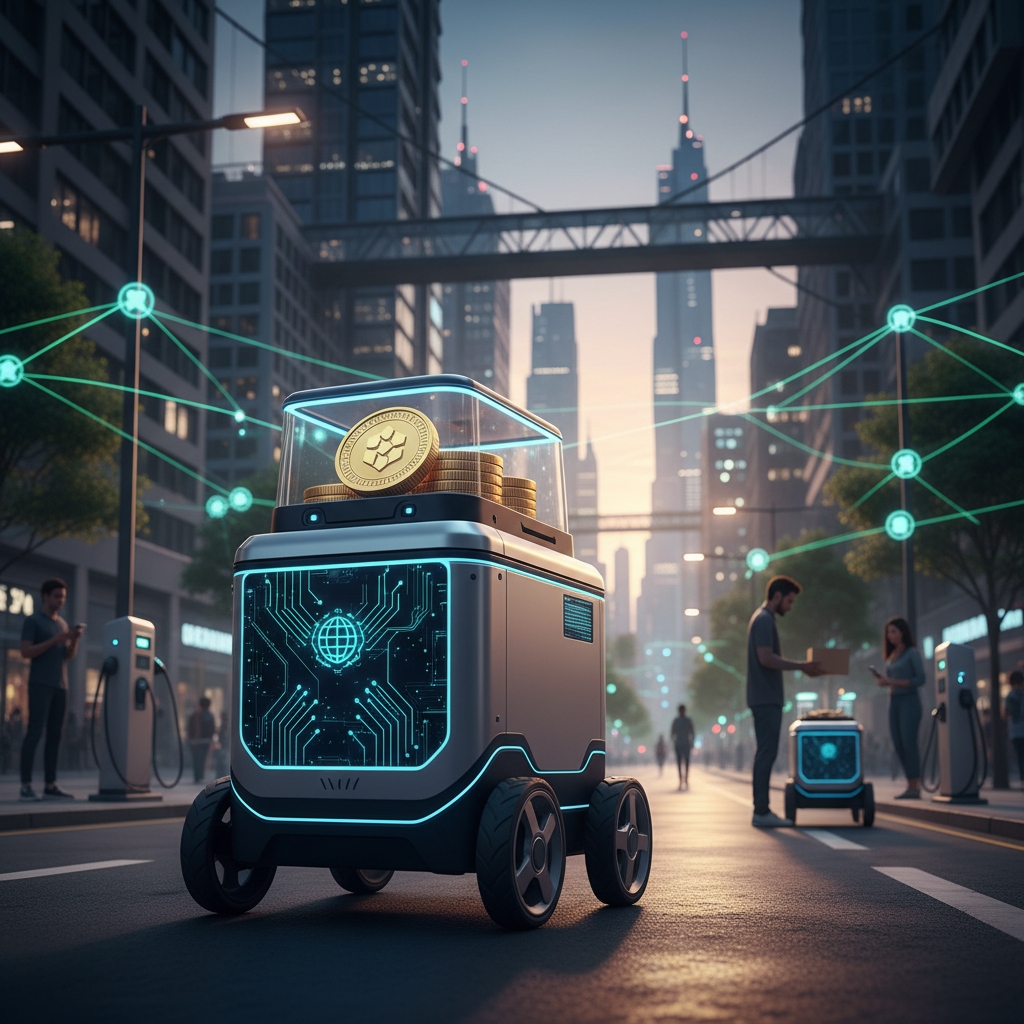
Decentralized Physical Infrastructure Networks (DePINs) represent a rapidly expanding segment of the Web3 landscape. These networks leverage blockchain incentives to crowdsource and manage real-world physical infrastructure, ranging from wireless networks and storage to computing power and sensor data. The appeal of DePINs has intensified, particularly in conjunction with the exponential growth of Artificial Intelligence (AI), which demands ever-increasing computational and data resources.
The DePIN sector has witnessed substantial growth, boasting a combined market capitalization of approximately $9.73 billion as of May 2026, with over 440 active projects and more than 40 million connected devices globally. Moreover, leading DePIN networks generated roughly $150 million in on-chain revenue from actual customers paying for real services in January 2026 alone, indicating robust utility and economic viability beyond mere token speculation. Analysts suggest that DePIN could become a dominant theme in 2026 due to rising infrastructure demand from AI applications, with decentralized alternatives offering potentially cheaper, more flexible, and open access to vital resources.
The Peaq Demonstration: A Glimpse into the Machine Economy
Peaq positions itself as a foundational infrastructure layer for DePINs, claiming to host over 60 applications across more than 20 industries with millions of devices connected on-chain. The recent demonstration involving the Serve Robotics delivery bot served as a powerful validation of the DePIN thesis. By enabling a machine to autonomously identify itself, verify its work, and collect payment, this model fundamentally diverges from traditional robotics-as-a-service.
The strategic choice of Tether's USDT for settlement highlights a critical aspect of machine-to-machine commerce: the necessity of stablecoins to mitigate price volatility. Such stability is paramount for autonomous payments, as machines cannot absorb significant price swings that would render transactions impractical. Integrating Solana as the settlement layer further emphasizes the demand for high-throughput, low-latency blockchain solutions capable of handling frequent, micro-transactions efficiently.
Broader Implications for Web3 Adoption and Innovation
This development signifies a crucial step in integrating Web3 technologies into daily life. It extends the utility of blockchain beyond finance and gaming, demonstrating its potential as an incentive layer for diverse physical infrastructure. The scalability of such a model could unlock significant new use cases for stablecoins in machine-to-machine transactions, independent of retail speculation or trading volume.
As the blockchain industry matures, the focus is increasingly shifting from speculative hype cycles to delivering real utility. Initiatives like Peaq's robot payment demonstration exemplify this transition, showcasing how blockchain can serve as invisible infrastructure for tangible services. This move towards decentralized, autonomous physical infrastructure holds the promise of fundamentally reshaping economic models across various industries, from logistics and smart cities to energy and data, paving the way for a more integrated and efficient future.